
Enjoying The In-Between
And the thrill of interactive horror.

As I write this, I’ve just started reading Lovecraft Country, I’m (really) looking forward to the second volume of the fourth season of Stranger Things and I’m a few hours into an interactive story called Little Hope (more on that later).
While the three tales are totally different, taking place in different settings, with varying monsters, characters and narratives, they’ve all successfully placed me in the in-between; a headspace where I spend time thinking about where their stories are going next. Of course, there are threads and character traits you can use as a foundation to predict what’s going to happen, but where these narratives end up is a surprise.
In his memoir On Writing, Stephen King said he doesn’t plan his novels. Instead, he says, “I want to put a group of characters (perhaps a pair; perhaps even just one) in some sort of predicament and then watch them try to work themselves free.” I always loved that idea, and it’s something I’ve tried to apply (sometimes successfully, sometimes not) to my own work. I guess, in some ways, it’s about not just embracing the in-between, but having total faith in it.
A few years back I played a video game called Until Dawn. Sold as an interactive horror experience, it follows a group of friends trapped in a remote mountain cabin, and the terrifying events that follow. The setup’s exactly as you’d imagine it, leaning into the slasher tropes I love. However, unlike a movie, it’s your job, as the player, to not only enjoy the story, but decide who makes it out alive.
And so followed a series of nights playing through the chapters, making the most of the game’s butterfly effect system to figure out whether a badly handled conversation would eventually lead to someone else’s demise.
Last week, I started Little Hope. It’s created by the same team behind Until Dawn but this time, is set in a fictional town in Massachusetts, and looks to be heading into a dark story of witchcraft. It’s just as good as its predecessor, using conversations to build interesting dynamics and tension, and setting up potential disasters (or not) in future.
So, if you enjoy reading or watching horror, check out Until Dawn, Little Hope or The Quarry, their brand new story that dropped earlier this month. Not only is it a refreshing, original way to enjoy the genre, but it might turn you into a monster.
This isn’t the first time Josh Malerman’s name has appeared in this newsletter and it probably won’t be the last. And though I’ve read some great stories this month, I think Pearl tops them.
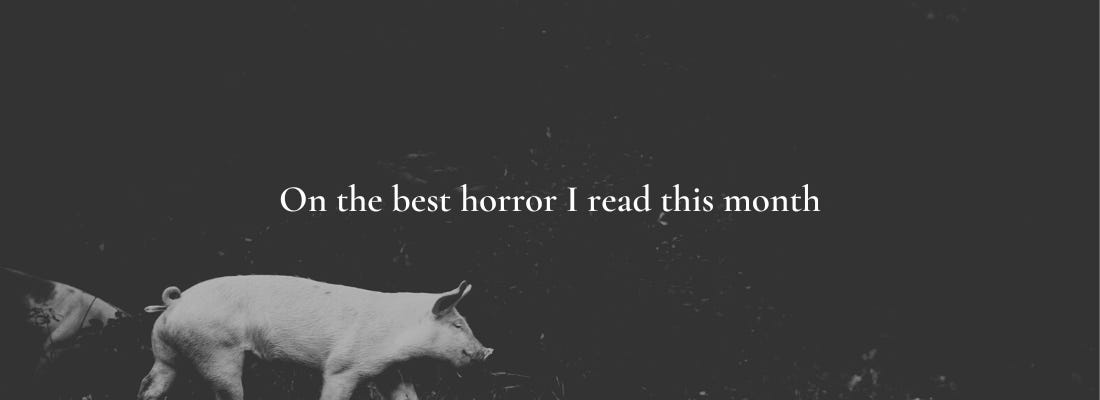
In short, Pearl is the story of a telepathic pig on Kopple farm with a bad eye and bloodthirsty intentions. It sounds like a premise that shouldn’t work, but it does, to the point that I’m now wary of pigs.
Before I started reading, I saw it compared to Carrie and even Charlotte’s Web and while elements of those are there, it’s also very much its own monster. In the book’s acknowledgements, Malerman talks about how, while writing, he spent countless hours on farms staring into the eyes of pigs, and that resonates here.
Pearl is a creature horror through and through. There’s lots of blood, lots of death and some pretty grim descriptions. But what stood out above all of that was the sense of originality. It was the idea of Pearl that carried me to the end and left me excited, as a reader and a writer, about why we put pen to paper.
Before you go
I live in other corners of the internet. Every Tuesday, I post new micro-fiction on TikTok. I also attempt to keep an Instagram updated and tweet every now and then.
/ JW